Sunday, October 27, 2019

One month at my school

Secondary School Students and Teachers
25 Octoba 2019 Ijumaa (Friday)             I took the full two weeks before I started teaching at my assigned secondary school. But I did participated in grading form IV mock NECTA (standardized national) exams. I was "grounded" to school by mkuu (headmaster) on the first my first Friday at the school-I couldn't go to town to buy materials to install solar at my residence. So Beth, my neighbor and teacher and I had to go on Saturday. On this particular this late Friday afternoon, the academic master congratulated me (hongera is the verb he used) for continuing diligently to grade some left over form four biol exams since all the other Tanzanian teachers left the teachers’ staff room.

This is a pre-NECTA (mock) exam. When a form IV student doesn't pass the NECTA final, there is zero chance the student can go to form five (O level), A level, and later to university.

Guess what, the form IV biology exam scores so far is 3, or 15, or 40s or 50s, out of a total of 100. Only one scored 70. very disappointing. I have not started teaching, it will be Oct 7. form I+II biology, form I chemistry

I have not taught secondary school kids before, only college students in USA, meaning teenagers’ behaviors are a new experience for me, let alone in a foreign land, with different marking systems and requirements.

Devious is the word I can think of for the school kids here in Tanzania. 
They have
  • stolen a blank exercise notebook from me, twice;
  • tried to tell me that I borrowed a green color pen from them and not returned it when the notes in green were written in 2015 by a past volunteer;
  • stolen a red pen so they can use it to revise the mark on the exam;
  • cheated in exams by copying from one another and thereby copying the wrong answer. For example, more than 10 students had the wrong answer for the question “what is biology”. They wrote it is the study of the living and living things and non-living things;
  • borrowed my copy of past exam questions published by the Education Ministry and never returned it;
  •  constantly chatted in class, not only the girls, some boys too; even walking across the classroom to the other side of the room while I was talking in front of the class.

The above are common practices, teachers are well aware of them all.
New to us American volunteer teachers is that sometimes the exam questions are written in poor English. We get a laugh, but feel sorry for the kids. For example, in an English language exercise, the students are asked to put a question mark to each statement, such as “The dog like meat.” The students asked me to help them. I recognize the question is to convert the statement into a question. I used to see it in my tutoring for English Language Learning.

Another common practice is on some teachers’ part is if there is a problem with the exam question, and that question is worth 20 marks, the teachers just take the question off the table, and every student loses 20 marks! This did not happen in my school, but my cohorts reported happening at their schools.

A third practice among teachers in the Academic Office is to ignore a revised mark if the students contest the exam score. I told the academic master that at least revise the score for several students whose original grade was F and now their grade became D. That makes a difference to the students’ records. I let it go when the grade did not change upon re-scoring.

Multiple Reasons For Why People Do The Things They Do.
Some of them may be:

  •  Primary school is taught in Kiswahili, except for English language. So the kids had 7 years of one language and then in one semester they have to face with English being used for all subjects except for Kiswahili.
  • Some teachers are not as fluent in English as others.
  • The Education Ministry mandates all schools to report test scores, and academic offices want to get the job done and move on to the next task.
  • Some kids have poor grades in multiple subjects. Some kids do very well.
  • Kids, especially in boarding schools, follow senior students as their role models, and sometimes the role models are not good one.
  • The school system is harsh, once a student does not pass the Form 4 NECTA, the student is out of school. The student can re-enroll in private schools are private candidate to retake the NECTA in the following year, and that means paying tuition, 1.2 million TSH/year, and that is cheap in the nation.
  • Textbooks are expensive, so students take notes. Some teachers do not even have textbooks.
  • The government only recently provided free education for all secondary schools, but parents have to pay fees, and other incidentals.
  • Some families need the children to help work on their farms. One estimate provided by my second headmaster is 30% of rural eligible kids are not in school.
  • Tanzanian culture is to share, so the concept of property is different from western viewpoint. History of socialistic culture is still very strong in Tanzania, and tribal cultures are practised. For example, if you give them a flashlight if the electricity went off, don’t expect them to return your flashlight.
  • Cheating is rampant, even in India. A recent news article (Oct 22 2019, cnn.com) on Indian university students voluntarily wear a cardboard box over their heads so as to test cheating prevention. That news went viral in India.
  • Kids like everywhere want to push boundaries.
Experiences for each Peace Corps volunteer may be different, depending on each individual situations and conditions. This blog contains my opinions and viewpoints, it does not reflect the Peace Corps organization’s.
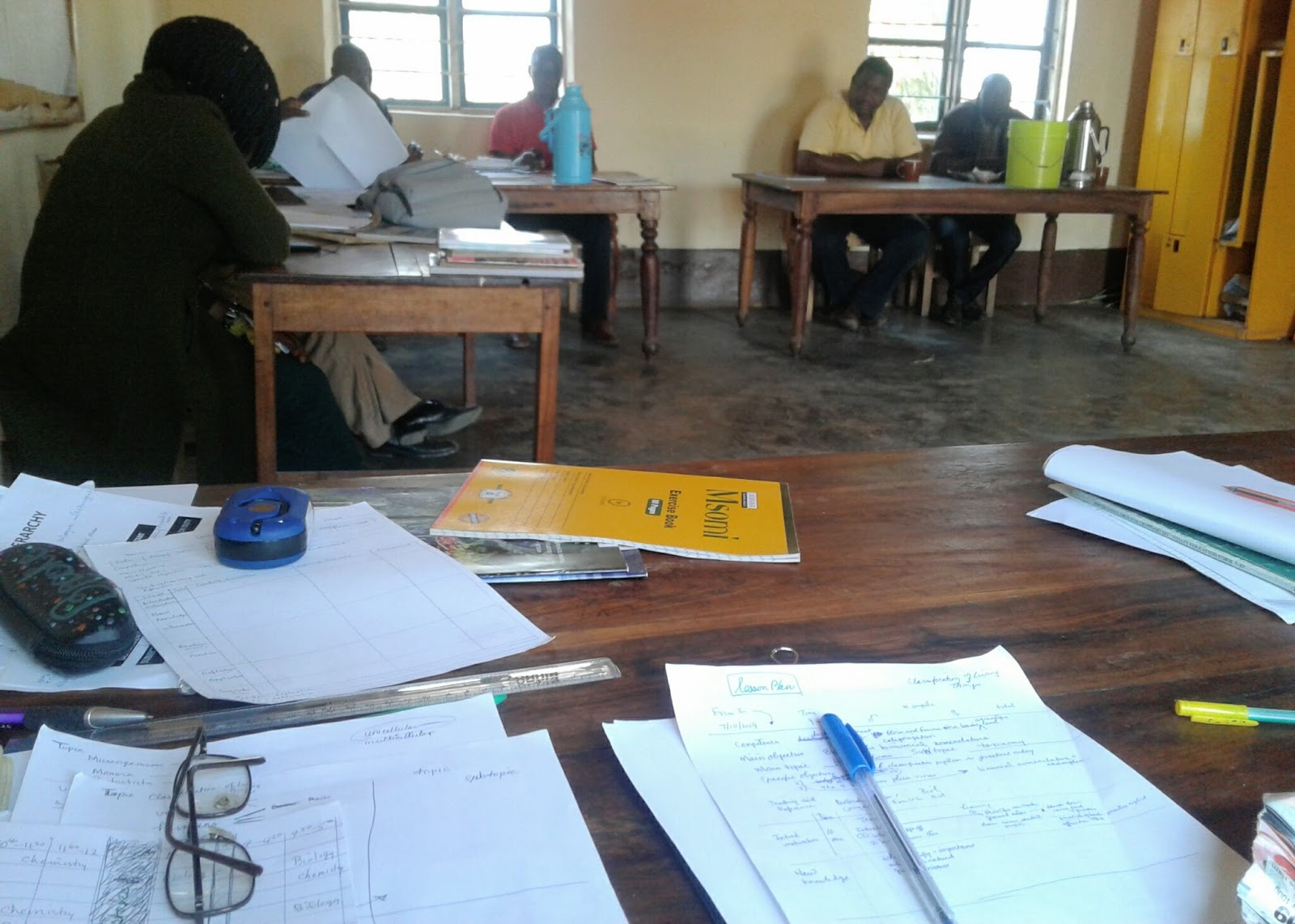
teachers' staff room-the front left side is
my "office desk" that I share with another teacher
the cement floor has pock marks, and trash
(no trash can in classrooms.
This room does not even have a door

Indiana university students voluntarily wear boxes on their heads to prevent cheating. Oct 2019 cnn news

to prevent students from cheating,
one volunteer in another school
had students sit in opposite direction
so each other so they cannot peak at answers.
This will not work in a class of many students


The windows do not have glass:
this is my intern school, we, trainees then,
were having our lunch


Saturday, October 26, 2019

I am now officially a volunteer


Swore in—I am now officially a Peace Corps volunteer
18 Septemba 2019 Jumatato (Wednesday)    A big day. The deputy minister from the Department of Education came from Dodoma to our training center in the Tanga Region. The auditorium was decorated beautifully with the colors of the American and Tanzanian flags. We practiced singing the national anthems of both countries, and a song routine for performance. I played the bongo drum, no singing and dancing for me.

One part of the ceremony was cutting a cake and feeding the VIPs. The youngest and the oldest trainees were chosen to do this honor. The ritual is to first feed the cake to the cutters, and to cutters’ host parents, and then the VIPs. All very symbolic. My cohorts told me that when baba William came up front and hugged me, it was moving.

The 5 families hosting us 5 of the Mashindei unit all wore the same patterned clothes, the black background with yellow flowers. The day before, while the trainees were rehearing the swearing in events, the assistant director of Peace Corps Tanzania brought me a tangawizi soda (ginger beer), my favorite. Coca Cola did right with that product.

After lunch, the trainees presented the host families with the picture we took of the family. What I did not expect was another round of gifts from the host families to us trainees. I got a flower lei, and a wooden heart-shape plaque carved with my name, and the date of my becoming a volunteer, and the word Hongera (congratulation). Dada (sister) Lucy baked another cake for me. We shared it among our Mashindei families. 


The stage of auditorium where the swear in event
was held was decorated with American
and Tanzanian flag colors
The youngest, Sydney B, and I were selected
to cut the cake to ceremonially serve VIPs

The trainees were expected to perform. We
50 trainees did song and dance numbers,
with music from popular songs,
with our own composed lyrics.
I was in the percussion section,
and got the play the bongo on the right.
I ain't doing the dancing and learning 5 songs
just to perform in 4 short rehearsal days.

Host family baba and dada (sister)
showering me with parting gifts
The Mashindei unit 5 for our farewell picture:
left to right-Sydney E, language teacher Hamisi, Alice, Diego,
Mollie, Anika. We are scattered to four corners
of Tanzania from this day forth for 2 years of service

Another baked cake on swear
in day, from dada


Kwa Heri Host Family

15 Septemba 2019 Jumapili (Sunday)               Last evening was the last night I was staying in the mountain with the host family. For dinner, my sister Lucy baked me a caki (cake), and had soda at the dining table. The soda bottles looked like candles to me, which made dinner very special. Mama Rose gave me a beautiful kanga as a parting gift. Baba William already gave me a lovely black skirt with yellow flowers. He had a fundi (tailor) came to the nyumba (house) to take measurements for the whole family, shirts for the men, skirts for the women. Then the parents also packed me some ginger and cinnamon powder for spiced tea, and some ginger roots. I was so touched.
Normally dinner is very simple, cucumbers are eaten as fruits, same as banana, oranges, and mangoes. Lately, the mango season is over, so sad. We trainees all love mangoes.

This morning, the Peace Corps car picked us up, and we all said goodbye (kwa heri) to our host families. We will stay at gesti (guest houses) for 4 days and then be dispersed to our teaching sites.

First week of September 2019        I eat lots of fruits, drink plenty of spiced tea. I also experienced drinking fresh cow’s milk, shucking corn, which landed a knife wound into my left hand, at the base of the thumb. A few weeks back, I cut myself shredding coconut on a special contraption. City folks (i.e., moi) don’t know how to do anything - too soft…
It’s hard work after spending 7-8 hours at the training center, because the trainees have to participate in household activities, meaning doing chores. This cuts into my language study time. By the time the family eats dinner, it is nine-ish or later in the evening. I do some work, but usually fall asleep.

Lakini (but), I have become the queen of cooking mchicha, African spinach, in the host family!


Mchicha (spinach) plot on
host family's farm
African spinach with tomato, onions-
I cooked this, with the ladle as stirrer,
cooking pot, and serving pot,
with only salt for seasoning!
Passion fruit vine climbing along a banana tree

For recreation, Peace Corps had intercultural event #2. I read some short poems, and poem of a string of haiku, of which the last stanza was written in Kiswahili. Mama Rehema Kuptama, the Peace Corps premier Kiswahili language program trainer, clapped her hands. That was such a compliment.

Incidentally, the haiku I wrote landed me the first prize for the previous week’s competition event, The prize was a refrigerated Snickers bar. Let me tell you that a Snickers bar never tasted so good before. It was the first one after lading in Tanzania, nice and cold.

Friday, August 30, 2019

Mbeya Assignment

Got assigned to a boarding school in rural Mbeya Region, southern highlands. Leaving tomorrow for site visit one week. Travelling two days because we need to meet bus schedules, staying overnight in a stopover then overnight at Mbeya City, then my replacement PCV will take me to the school to meet the headmaster, called mkuu in Swahili.

We have to work out the logistics with PC staff and other current PCVs who are helping us to get to our destinations.

The school has of elevation 1995 meters, Mbeya is the coffee producing region. Temperature in winter can be 11 degrees Centigrade-because I requested for a cooler climate since my mosquito bites can be very large.

Sorry for all the metrics, no time to do conversion, as I have very little time to send messages.


Mashindei Mtn waterfall, some host family members,
my PST group
A giant 7-inch!!! mango we all ate at my host family dinner one evening. Most of the volunteers and trainees love the mango, embe

Sisal is a major product in the Tanga Region
where we are training. The fibers from the agave plant
(Mexican origin) are made into baskets and other products


Goats came to visit our "office"
and language classroom.
Note the wall is like some old European
or Russian apartment walls-peeling paint,
ugly patches, shabby

The 6 trainees assigned to Mbeya Region. We will be sworn in the following day as volunteers: left to right-Alyssa, Makala, Ronnie, Kenta, Zoe, Alice.

Saturday, August 24, 2019

Week 6

24 August 2019 Ijumaa (Friday)               High stress last week due to mid-term oral and written Kiswahili language exams, plus completion of online quiz on safety and security response. Our Mashindei unit of 5 trainees have no cell service in the mountains, so I can only access online and get connected to the rest of the world while in the training town, and for the quiz, I had three tries. My second try was worse than attempt one.

Well, my third attempt was finally resulted in 81 points out of 100. I passed - needed at least 80% to pass. This week, my language tests came back. I bombed the written one, but at least I passed, barely. The score must be above 60% to pass.

I was rated as novice medium, very likely the lowest rank among 51 of us.

Folks, I was a A/B student before, in most of my school years, so now I have to admit that I am not a top student anymore.

Vote With Feet

I admire the people who designed the training program; they are excellent project managers because I can recognize most of the places where they need to troubleshoot and solve issues on the fly.

There are sessions where facilitators ask participant feedback on questions/talking points. The facilitators use participation methods to engage trainees. I like the parts where we vote with our feet. The facilitator would ask a question, and we walk to the line of neither agree nor disagree, or to the line of agreement, or the line of disagreement. For example, walk to a line if we think most chefs are mostly men, and walk to a line if we think cooks are mostly women. That was a session on gender roles and perceptions.

Brief on the Kiswahili Language

·        60% Bantu, 30% Arabic, 10% other (e.g., Hindi, some English, French words, etc.)

·        Global top 10 language out of 6000 languages

·        Top 12 critical languages recognized by the US government and the world

·        Estimated 250 million speakers

·        Tanzanian speak the best Kiswahili among the East African countries of Kenya, Tanzania, Uganda, Rwanda, Burundi, South Sudan.

Peace Corps-Tanzania has the best language teachers, who are our teachers. Case in point, Kiswahili in the online language learning software Duolingo is developed by Peace Corps language teachers. 

Some of us learners find the language very interesting. It can be very condensed, s single word, a verb, alilalafofofo, is all it takes to say she was asleep, in a deep, deep, deep sleep. Yet, on the other hand, the color orange is three words, rangi wa chungwa.
A dance troupe on traditional dance
Our language teachers in traditional clothes dancing


with the Duolingo language instructor
With another senior language instructor


making ugali, maize (corn meal) paste
We had a sports day for fun


Wednesday, July 24, 2019

Korogwe Week 2


Korogwe Week 2

23 Jul 2019 Jumanne (Tuesday)               Incredible-we, 51 American PC trainees (PCTs), were sent to 51 host families last Thursday evening, only under five days ago, and left Alexandria, VA, only 14 days, BUT we feel like it is a long time ago when we left American soil.

Mashindei Mtn
My group of five PCTs are in the Mashindei Mountain area, in a village of about 2500 people. The PC training program director came to visit us from Dar. He said we have the best community location. Today, it is shamban, harvest day. The secondary school we are based at sent out the students to pick corn. It so reminded me of the lickanje harvest I participated in October 2018 in Slovenia, another near half-way-around-the-world place.


Homestay farm house living room


Shamban-maize harvest-when the ear is picked, I bend the stalk.
The back porch is the center of activities


Consider the back porch the outdoor kitchen area, with charcoal stove. Host family has gas stove and refrigerator indoors.

The next level beyond the porch is the "backyard", where laundry, some dish washing, and trash burning activities all occur. The garden of many fruit trees are right there also. The farm grows ginger and onions.

Some students (percentage unknown, I will find out details when I am installed at my teaching site later in the year) are too poor to have meals when they attend class. Today, they can get a free meal in school. The school sells the corn to bring in income for the school, to buy more school supplies, etc.
Our training is complete immersion within host family and community to absorb culture and Kiswahili. I am not doing as well as other young PSTs. I know the words, but when I hear them, the processing from hearing to translation is slow, so I don’t understand.

My host family has a lovely large house, and each bedroom has its own bathroom, quite a luxury. Baba, Mama and binti (daughter) are wonderful people. Mama’s brother is high up in the Tanzanian foreign service, though Mama doesn’t speak English. I met more of her visiting family this morning; they were from Dar.


I love the spiced water the people make tea and coffee with; it is ginger and sometimes added lemon grass on top. I had been drinking my tea and coffee with ginger powder before I left, so this is added familiarity, though only a few of my fellow PSTs had experience with spiced water before.

No internet connection for laptop, and no bars, i.e., no mobile wireless service in the village for us PCTs, though we see our host families are connected with their mobiles. So we will have to wait to get into town tomorrow, when we attend classes.

Wednesday, July 17, 2019

Korogwe Week 1


Moved to Guest House, Farewell Modern Hotel Room

Jul 14, 2019 Sunday                     Four plus hours by motor coach north to rural area for remaining training. On the highway, each big vehicle must be weighed, not only commercial 18-wheelers, and be approved by inspectors  at several check points.  

We arrived at the Korogwe Teachers’ College amid drum, song and dance by the welcome party. Fed, we then went in groups of 5-6 to guest houses in town. My gesti (rooming house) is a 10-15 minute walk to the College. The College is one of the training sites.

My room in the gesti has a giant foam bed with mosquito net, a small table, chair, TV, A/C, fan, and private bathroom. In the bathroom, there is no separate shower compartment, so the floor of the bathroom is wet after a shower. A cold shower in winter (we are in winter)? Well, it is not too bad. Like jumping into a pool—first mild cold shock, then afterwards, it is fine. It is 72oF, up to 82oF, when we are in an open auditorium, not hot. But the library, where we dine, is hot, even at 6:30 p.m.

Keep private clothes private, even handkerchiefs and socks, we are told, so we will do that. Sometimes if you have to hang your underwear to dry outside, cover the underwear with kanga (or spelled khanga, though not kangha [Sikhism small comb]), a large colorful cloth used for many things by Tanzanian women.

To catch up on news, I watch Alzazeera, which is like CNN, but much better. Alzareera won a broadcasting award.

There are 51 trainees, and a host of program trainers, language trainers, technical (education) program staff. Next week, the trainees will be placed in host family homes.


Korogwe welcoming party as we get off the bus,
with song, dance, drumming
My gesti room


Everything one needs: the latrine with flush, the shower head, the sink, water bucket for additional floor rinse, flip flops to wear inside the bathroom


Walkabout in Dar

Jul 13, 2019 Saturday   We felt like school kids let out at recess, couldn’t wait to run outside to play. We had language class and training overview on the next phase north in Tanga Region (like district). We were told that the hotel stay the previous week was to get us acclimated somewhat. The amenities moving forward would be sparse or non-existent moving forward.

At Dar, it was bustling, thriving, and I already spotted at least two Chinese restaurants while we were walking about. We followed leaders who showed us how to take the bus, the DART (like BART, rapid transit), and more bus to get to where we need to go if we are in DAR for training or medical visits.


And guess what, the DART is a joint collaboration of the Chinese and Tanzanian efforts. I was told by the Chinese-Tanzania Security not to take any pictures of the DART system. I only wanted to do show and tell to folks back home, the interconnected bus, rapid transit, and buses to other parts of Africa. Wow! That someone might think of sabotaging DART structures?


Women carry things on their heads
The "White House" in Dar


See KFC?
Roadside kitchenware stand


Wakala stand at bus station: person who sells mobile phone services.

Thursday, July 11, 2019

First Few Days in Dar es Salaam


Day 2 Pre-Service Training
Jul 11, 2019 Wednesday              We are referred to as trainees. Today, we were not at the hotel training, we were at the Tanzania Peace Corps headquarters. Lovely trees and flowering plants abound.

Breaks are called chia (mid morning), chakula (lunch), soda break (mid afternoon).

As usual, I am still recovering from my lack of sleep, and I struggle not to fall asleep during the sessions.

We got our medical kit, mosquito net and a travel kit of meds.

We either got our sim cards for Airtel carrier or loaner phones, and we get our banking done, per idem is 10,000 TSH/day, i.e., USD $5. This means we have to budget…Some of the pay right now is to pay for cell phone carrier service. It was confusing for me to configure and purchase air time (data). People are kind to me, the oldest in the group.

PC TZ trainees at Sea Scape Hotel 7/10/19
Medical kit, travel kit to carry at all times, mosquito net


Flying over to Addis Ababa and Dar es Salaam
Jul 8, 2019, Monday      5 am we boarded two buses to Dulles Airport, for Ethiopia. We arrived 13+ hours later, stiff, and tired. But I always watched my three movies, dozed off here and there while reading. It was time to catch some z’s after another two non-sleeping nights packing/cleaning.

There was a five plus hour-delay at Addis, but we finally boarded a plane, arrived in Dar, and were greeted warmly by Peace Corps Tanzania staff. Ethiopian Air fed the passengers a nice chicken curry meal in the lounge because the flight was delayed. Then after we finally boarded the plane, we were served dinner again. Then when we went to the hotel, we were fed again, at 9 pm.

Going through customs at Dar airport was a waiting process. I was the second in our group to be in line, but ended as the last one to complete the passport control because I didn’t fill out a form. So back I went to do it, and started over again.

When it came to luggage inspection, I was so disappointed. Starting in June, Tanzania banned plastic bags. The US State Department listed this on their web site, and we were warned about it. My two pieces of luggage were just put on a giant machine for scanning, nothing like opening and searching through the luggage—and I had carefully not brought anything in plastic bags, only zip lock bags. Of all the trouble I had gone through not to separate things in plastic bags, the inspector didn’t even look!

When one sees the local language, plus English, plus simplified Chinese on airport and store signs, one knows that the People's Republic of China had pervasively spread into Africa. At Dar airport, the Chinese red passports were treated by a different custom control line.


Departure and Orientation Day
Jul 7, 2019, Sunday       4 am the taxi came. I had no more time, all the incentives (rewards for the Tanzanian teenagers if they earn good grades) were not packed. And I agonized over whether I remembered to pack the power cord/adaptor to the laptop in my luggage.

At MSP airport, I lost an autographed book while I was readjusting balance to pull two near 50-pound suitcases, plus backpack, plus a heavy bag/purse stuffed full of things.

I arrived at Reagan Washington Airport, and waited 2.5 hours for the hotel shuttle to pick me up. When I saw another woman with two pieces of big luggage, I ventured to ask her if she was going to Peace Corps. Sure enough.

At the hotel, a large group of us had to take a pre-staging survey and then a post-staging survey, all expected to access via internet with our own devices. I hate the tiny typing keyboard on a phone.
After many tries, finally without any typos, I completed my tasks, the second last person to finish. The group of volunteers were mostly young people.
Staging orientation in Alexandria, VA, 7/719 
A few days before, I did not wake up on time to meet with the estate planning lawyer, because I had not been sleeping for two days, trying to pack up my possessions in the house like I was moving.

In hiatus Jan 8 2022

update January 11, 2023 No longer any posting due to covid pandemic evacuation Mar 2020.  Peace Corps started slowly mobilizing to certain c...